
What does Passivhaus mean?
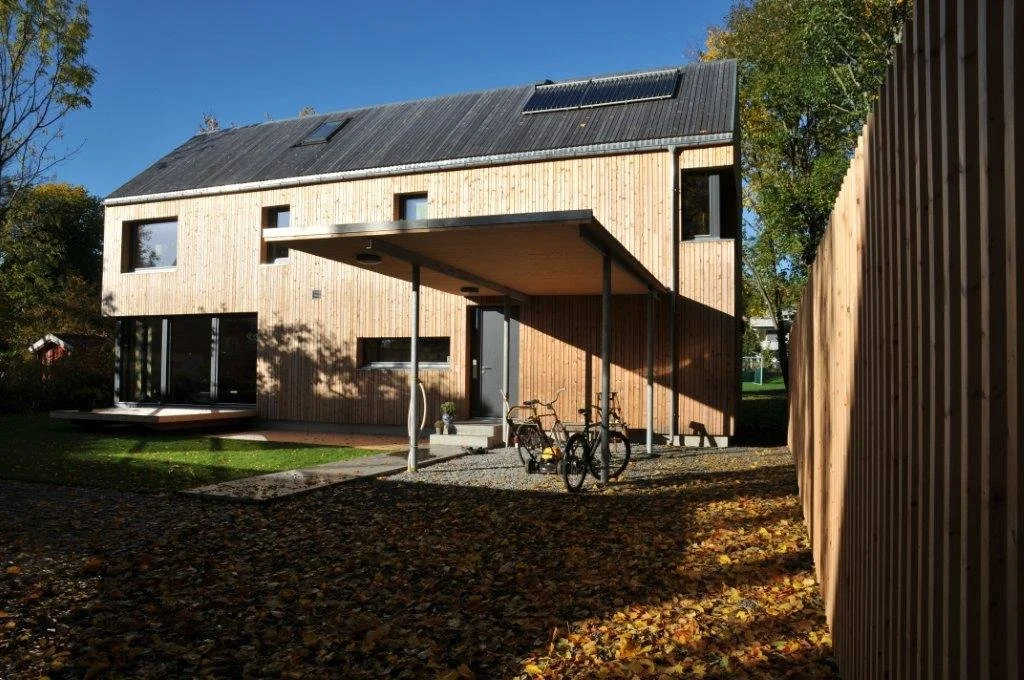
Harald Brekke, CC BY 3.0 <https://creativecommons.org/licenses/by/3.0>, via Wikimedia Commons
Passivhaus (or "Passive House")
is a building design standard focused on extremely high energy efficiency, originally developed in Germany.
The core idea is to build homes that need very little energy for heating or cooling, by focusing on the building's fabric rather than relying on mechanical systems. Key principles include:
Super insulation — walls, roofs, and floors are insulated far beyond standard building regulations, keeping heat in (or out) much more effectively.
Airtightness — the building is sealed to prevent draughts and uncontrolled air leakage, which is a major source of heat loss in typical homes.
Mechanical ventilation with heat recovery (MVHR) — since the building is so airtight, a ventilation system constantly brings in fresh air while recovering heat from the outgoing stale air, so you get good air quality without losing warmth.
High-performance windows and doors — typically triple-glazed, designed to minimise heat loss while maximising useful solar gain.
Elimination of thermal bridges — careful design avoids gaps in insulation where heat could "leak" through, such as at junctions between walls, floors, and roofs.
Optimised solar gain and shading — windows are positioned to capture useful winter sun while avoiding summer overheating.
The result is a building that stays comfortable year-round with minimal heating or cooling input — often described as needing barely more than a hairdryer's worth of heating on a cold day.
Buildings can be certified as meeting the Passivhaus standard through rigorous design modelling and testing (including an airtightness test).
It's increasingly popular in the UK for new-build homes and retrofits aiming for very low energy bills and a comfortable, consistent indoor climate.